Elevating Your Space with Birds on Branch Wall Art SVG Laser Cut Designs
There is a distinct satisfaction in watching a flat sheet of material transform into a intricate piece of decor, especially when that piece captures the delicate silhouette of nature. The Birds on Branch Wall Art SVG Laser Cut trend has taken the maker community by storm, and for good reason. These designs offer a perfect blend of organic beauty and geometric precision, making them ideal for everything from rustic wooden signs to modern faux leather accents. However, diving into laser cutting or CNC routing without a clear understanding of file compatibility and material behavior can turn a promising project into a frustrating experience. Whether you are a seasoned entrepreneur running a small business or a hobbyist looking to spruce up your living room, avoiding common pitfalls is essential for achieving professional results.
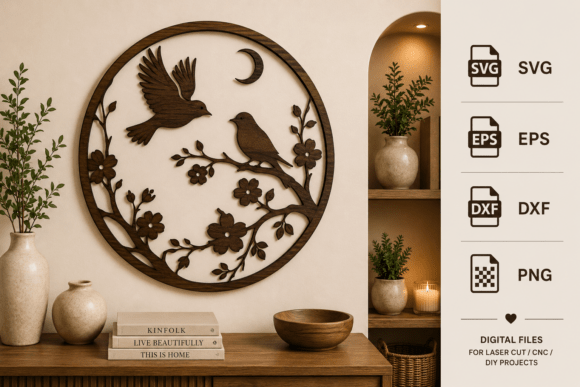
At its core, a Birds on Branch Wall Art SVG Laser Cut file is more than just an image; it is a set of instructions for your machine. When you download a comprehensive zip file containing SVG, DXF, PNG, and EPS formats, you are unlocking versatility. The SVG and DXF files are vector-based, meaning they use mathematical paths to define shapes, allowing your laser cutter or CNC router to trace lines with infinite scalability. The high-resolution PNG with a transparent background serves a different purpose, often used for printing sublimation designs or creating stencils. Understanding the specific role of each file type is the first step toward success. Many beginners make the mistake of importing a raster image like a JPEG into a vector cutting software, expecting clean cuts. This inevitably leads to jagged edges and wasted material. Always ensure you are utilizing the vector files (SVG, DXF, or EPS) for any operation involving cutting or engraving paths.
Navigating Material Choices and Machine Settings
One of the most frequent oversights occurs during the material selection phase. The beauty of these digital files lies in their adaptability; you can create your art out of wood, canvas, faux leather, paper, fabric, or even metal sheets if your equipment allows. However, treating all these materials as identical in terms of machine settings is a recipe for disaster. For instance, a power and speed setting that perfectly cuts through 3mm plywood might completely burn through faux leather or fail to penetrate a dense hardwood.
When working with faux leather, which is popular for its sleek, modern look in wall hangings, users often forget to account for the plastic coating. High heat can melt the edges, creating a raised, uneven bead that ruins the aesthetic. A better approach is to run a test strip on a scrap piece of the exact same material. Adjust your frequency and speed until you achieve a clean cut without excessive charring. Similarly, when using wood for indoor or outdoor hangings, consider the grain direction. Cutting against a heavy grain can cause tear-out, whereas aligning your design with the grain can enhance the natural texture of the branch elements in the artwork.
Another critical factor is the intended environment. If you are crafting Indoor Outdoor Hangings, the material durability becomes paramount. Paper and standard canvas may look beautiful initially but will degrade quickly when exposed to moisture or UV rays. For outdoor applications, opt for treated woods, marine-grade plywood, or UV-resistant acrylics. Ignoring this distinction can lead to a finished product that warps or fades within months, disappointing clients or ruining your personal decor investment.
File Preparation and Design Integrity
Before sending your Birds on Branch Wall Art SVG Laser Cut file to the machine, thorough preparation in your design software is non-negotiable. A common misunderstanding among new creators is assuming that a downloaded file is "ready to cut" straight out of the zip folder. While reputable designers provide clean files, issues can arise during the import process. Nodes may be duplicated, paths might be open where they should be closed, or overlapping lines could cause your laser to trace the same area twice, resulting in burn marks.
To avoid these efficiency killers, always inspect the vector paths. Look for "open contours" which can confuse the machine's head movement. In software like LightBurn, Illustrator, or Inkscape, use the "node edit" tool to weld overlapping paths and simplify complex curves. This not only speeds up the cutting time but also ensures smoother edges. Furthermore, pay attention to the scale. An SVG file is resolution-independent, but it may import at a default size that does not match your material dimensions. Always measure your physical stock and scale the digital design accordingly before locking the aspect ratio. Failing to do so can result in a design that is too large for your wood plank or too small to be impactful on a wall sign.
Maximizing Versatility Across Different Projects
The true power of having a multi-format download (SVG, DXF, PNG, EPS) is the ability to pivot your project based on available resources or client needs. Suppose you land a last-minute order for a fabric wall hanging but only have a CNC router set up for wood. If you understand your files, you can switch strategies. You might use the CNC to carve a mold or stencil from wood, then use that to apply paint or cut the fabric manually. Alternatively, the high-resolution PNG can be sent directly to a large format printer for a canvas print, bypassing the cutting stage entirely while still utilizing the same artistic asset.
Entrepreneurs and freelancers should also consider the layering potential of these designs. A single-color cut is elegant, but combining materials adds depth. Imagine a dark walnut base with a lighter maple overlay for the birds, or a fabric backing visible through the negative space of the branches. These creative decisions elevate a simple cut file into a premium product. However, this requires precise alignment. When planning multi-layer projects, include registration marks in your design file. These small targets help you align subsequent layers accurately, ensuring the birds sit perfectly on the branches without shifting.
Ultimately, the goal is to create something that resonates. Whether you are producing Wall Signs for a nursery, crafting gifts for friends, or building inventory for an online store, the quality of your execution defines your reputation. Take the time to learn the nuances of your specific machine and materials. Don't rush the setup phase. A few extra minutes spent checking file integrity, testing material settings, and planning your layout can save hours of rework and dollars in wasted stock.
By approaching your Birds on Branch Wall Art SVG Laser Cut projects with a mindset focused on preparation and material science, you transform potential frustrations into opportunities for innovation. The digital files are merely the blueprint; your skill and attention to detail bring the vision to life. Embrace the learning curve, experiment with different textures like canvas and leather, and always prioritize the longevity of your final piece. With the right knowledge, these versatile designs can become a staple in your creative portfolio, delivering consistent beauty and satisfaction for years to come.