Evaluating Shark Silhouette Laser Cut SVG Designs for Precision Fabrication
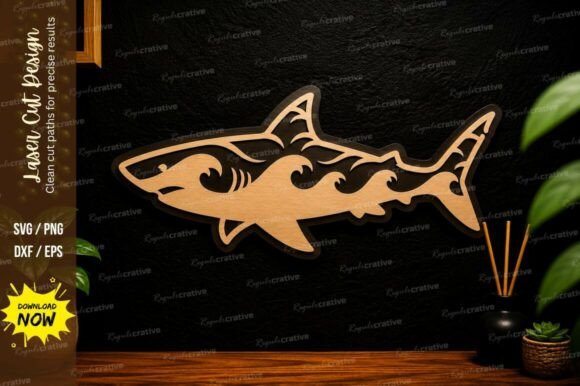
For digital fabricators and hobbyists working with laser cutters, the quality of the source file is just as critical as the calibration of the machine. A Shark Silhouette Laser Cut Svg Design represents more than just a visual image; it is a set of mathematical instructions that dictate how a laser beam interacts with material. When selecting a design package, particularly one marketed as premium quality, it is essential to look beyond the preview image and evaluate the technical integrity of the vector paths, the versatility of the provided formats, and the suitability of the design for your specific project goals.
This analysis breaks down what constitutes a high-quality shark silhouette file, how it compares to generic alternatives, and the practical considerations involved in choosing the right digital asset for wood, acrylic, or metal projects.
The Technical Distinction of Premium Vector Files
Not all SVG files are created equal. In the context of laser cutting, a Shark Silhouette Laser Cut Svg Design intended for professional use differs significantly from standard clip art found on free stock sites. The primary distinction lies in the cleanliness of the vector paths. Premium designs are meticulously prepared to ensure smooth and precise cutting. This means the nodes (or anchor points) are optimized to prevent the laser head from stuttering or vibrating during operation, which can lead to burn marks or jagged edges on the final product.
A high-quality file typically features closed paths where necessary for engraving boundaries and open paths for cutting lines, clearly distinguished within the layer structure. When you acquire a comprehensive package including SVG, EPS, PNG, DXF, and PDF formats, you are gaining compatibility across a wide spectrum of software ecosystems. For instance, while SVG is the universal standard for web-based design tools like Cricut Design Space or Canva, DXF is often preferred for industrial CAD software such as AutoCAD or CorelDRAW. Having access to both ensures that whether you are using a desktop hobbyist machine or a large-format CNC router, the file translates accurately without requiring time-consuming manual reconstruction.
Comparing File Formats and Software Compatibility
One of the most common decision points for creators is determining which format within a multi-format pack best suits their workflow. Understanding the tradeoffs between these formats is vital for efficient production.
- SVG (Scalable Vector Graphics): Ideal for most modern laser cutting software (e.g., LightBurn, Glowforge). It preserves scalability without losing quality, making it perfect for resizing the shark silhouette to fit various material dimensions.
- DXF (Drawing Exchange Format): Often the superior choice for users relying on older CNC controllers or specialized engineering software. It handles complex coordinate data robustly but may lack some styling attributes found in SVGs.
- EPS (Encapsulated PostScript): A legacy standard highly valued by graphic designers using Adobe Illustrator. It offers excellent print fidelity and is useful if the silhouette needs to be incorporated into larger branding materials before being sent to the cutter.
- PDF (Portable Document Format): Useful for quick previews, client approvals, or printing templates directly onto material for manual alignment before cutting.
- PNG (Portable Network Graphics): While not a vector format and thus unsuitable for direct cutting paths, a high-resolution PNG included in the pack serves as an essential reference for raster engraving settings or for creating marketing visuals.
Generic free downloads often provide only a single format, usually SVG, which may contain unnecessary metadata or grouped elements that confuse laser software. A premium Shark Silhouette Laser Cut Svg Design set eliminates this friction by providing clean, ungrouped layers ready for immediate processing.
Material Suitability and Design Application
The utility of a shark silhouette extends across various materials, but the design requirements change depending on the medium. When evaluating a design file, consider how the line weights and spacing will interact with your chosen substrate.
Wood and Plywood Projects
For wood projects, such as wall art or nursery decor, the simplicity of a silhouette is advantageous. However, intricate internal details (like gill slits or eye details) must be wide enough to prevent the thin bridges of wood from burning through or breaking off during weeding. A well-prepared design will have adjusted stroke widths to account for the kerf (the width of material removed by the laser), ensuring structural integrity in materials like birch plywood or MDF.
Acrylic and Metal Engraving
When working with acrylic or coated metals, the focus often shifts from cutting to engraving. Here, the vector precision of the Shark Silhouette Laser Cut Svg Design determines the sharpness of the etched lines. Clean vectors allow for consistent depth control, preventing the "wavy" look that occurs when a laser follows a poorly defined path. For metal tags or keychains, the ability to resize the vector without pixelation is crucial, as these items often require small, detailed execution.
Paper and Cardstock
In paper crafting, the speed of the cut is paramount. Complex nodes can slow down the machine, increasing the risk of tearing delicate paper. Optimized files reduce the total node count while maintaining the curve's shape, allowing for faster, cleaner cuts in cardstock projects like invitations or stencils.
Decision Factors: When to Choose a Premium Pack
Deciding between a free resource and a paid, premium package often comes down to the scope of the project and the value of your time. If you are prototyping a single concept for personal use, a basic free silhouette might suffice. However, for commercial production, client work, or complex DIY installations, the limitations of free files become apparent quickly.
Key indicators that a premium design is the right choice include:
- Consistency: You need multiple variations (e.g., different shark species or angles) that share the same stylistic weight and line quality.
- Time Efficiency: You cannot afford to spend hours fixing broken paths, closing open shapes, or converting file formats manually.
- Scalability: The project requires resizing the design from a small pendant to a large wall installation without any loss of definition.
- Machine Safety: Poorly optimized files can cause lasers to linger in spots, creating fire hazards. Premium files are tested for smooth toolpath generation.
Conversely, if your project relies heavily on artistic modification where you intend to completely redraw the shape anyway, the specific benefits of a pre-made silhouette may be less relevant. However, even in these cases, having a high-quality base reference in DXF or EPS format can accelerate the tracing and redesign process.
Limitations and Realistic Expectations
While a Shark Silhouette Laser Cut Svg Design offers significant advantages, it is not a magic solution for all fabrication challenges. Users must still understand their specific machine's capabilities. For example, no amount of vector optimization can compensate for a dull lens or improper focus settings. Additionally, while these files are "ready to cut," they often arrive in a standard size. Users must be comfortable scaling the design proportionally within their software to match their material bed size.
Furthermore, the term "silhouette" implies a solid shape. If a project requires intricate lattice work or internal cutouts that mimic texture, a simple silhouette may need to be modified or combined with other pattern files. The premium pack provides the foundation, but the creator's knowledge of nesting parts to minimize material waste remains a critical skill.
Making an Informed Selection
Ultimately, the choice of a digital design file is an investment in the quality of the physical output. A Shark Silhouette Laser Cut Svg Design that includes a full suite of formats (SVG, EPS, PNG, DXF, PDF) and boasts clean, optimized vectors provides the flexibility needed for diverse applications. Whether you are crafting custom home decor, producing educational models, or manufacturing small-batch goods, the reliability of your source file dictates the professionalism of your final product.
By prioritizing files that offer cross-platform compatibility and proven precision, makers can reduce troubleshooting time and focus on the creative aspects of fabrication. Always review the file specifications and format list before downloading to ensure alignment with your current software stack and material requirements. This due diligence ensures that the transition from digital concept to physical reality is as smooth and precise as the laser beam itself.