Personalized 100 Countries Map Laser Cut Guide
Whether you are a hobbyist looking to start a side hustle or a seasoned designer seeking high-quality assets for a client project, the foundation of your work often lies in the quality of your digital files. The Personalized 100 Countries Map Laser Cut collection represents more than just a set of images; it is a versatile toolkit designed to bridge the gap between creative vision and physical production. By offering original images without watermarks and no background in professional file formats like SVG, AI, and PNG at 300ppi, these resources cater to a wide spectrum of needs, from intricate laser engraving to high-resolution print media.
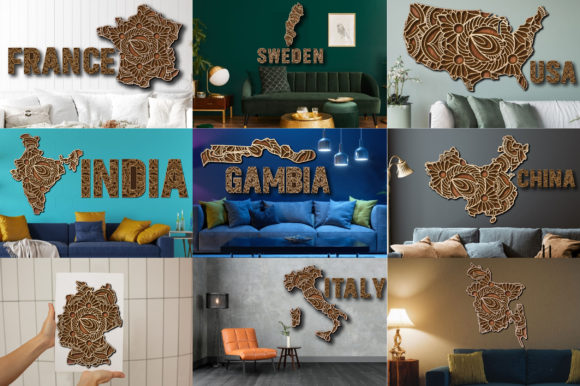
At its core, this collection provides precise vector outlines for one hundred distinct nations, ranging from Albania to Zambia. For those unfamiliar with digital fabrication, the value of a "laser cut" file extends beyond simple aesthetics. It requires mathematical precision. A jagged line in a low-quality JPEG might look acceptable on a screen, but when translated to a laser beam cutting through wood or acrylic, that same imperfection results in a rough edge or a broken piece. This is why the inclusion of SVG vector files is critical. Vectors allow for unlimited resizing with absolutely no quality loss. Whether you are creating a tiny keychain featuring the outline of Luxembourg or a massive wall installation depicting the entire continent of Africa, the geometry remains crisp and clean.
Why File Formats Matter for Different Creators
The utility of this map set changes depending on who is holding the file. When you receive the package containing SVG, AI, and PNG formats, you are essentially getting three different tools in one download. Understanding how to leverage each format is key to maximizing the value of your purchase.
For beginners and hobbyists, the PNG raster files are often the most immediate point of entry. High-quality at 300ppi with a transparent background, these images are ready to drop into design software like Canva, Photoshop, or even word processors. A teacher planning a geography lesson can instantly insert a clear outline of Japan or Brazil into a worksheet without worrying about white boxes ruining the layout. Similarly, a blogger writing about travel trends can use these transparent maps to create engaging social media graphics without needing advanced editing skills. The priority here is ease of use and speed; the work is already done, allowing the user to focus on content rather than technical tracing.
Conversely, professionals and entrepreneurs running small businesses in the maker space will gravitate toward the SVG and AI files. These vector formats are the industry standard for laser cutting machines (such as Glowforge, xTool, or industrial CO2 lasers) and CNC routers. A business owner producing personalized wedding favors or corporate gifts needs reliability. If a client orders a custom map of their home country, say, Ireland or Thailand, the file must be perfect. The AI (Adobe Illustrator) format allows for deep customization. A professional designer can manipulate anchor points, combine multiple country shapes into a single mandala design, or adjust line weights to suit specific material thicknesses. For this audience, the priority is flexibility and commercial value. The ability to modify the source file means the product can be adapted for endless variations, increasing the potential return on investment.
Tailoring Projects to Your Audience and Goals
The concept of a "Personalized 100 Countries Map" implies customization, but the execution varies wildly based on the end goal. Let's explore how different users might approach this same set of assets.
Educators and Publishers often prioritize clarity and accuracy. In an educational setting, a map of Germany or India needs to be recognizable instantly. Using the high-resolution PNGs ensures that printed handouts look professional. However, if a publisher is creating an interactive textbook or a large-scale classroom display, the SVG files allow them to scale the maps to fit any dimension without pixelation. The learning value here is significant; students can trace borders, color regions, or analyze geographical shapes without the distraction of complex topographical details that often clutter standard maps.
Marketers and Brand Strategists might use these maps to visualize data or represent global reach. Imagine a startup showcasing their international client base. Instead of a generic stock photo, they can laser cut a wooden plaque featuring the specific countries they serve—perhaps a combination of the United States, United Arab Emirates, and South Korea. The transparent background of the PNGs also makes compositing these maps onto branded backgrounds seamless. For marketers, the presentation is everything; these files offer a polished, bespoke look that generic clip art cannot match.
Artists and Crafters focusing on the "Mandala" aspect of laser cutting will find unique opportunities here. While the standard country outlines are perfect for literal representations, creative users can arrange these shapes into circular, mandala-style patterns. This technique is popular in modern home decor. A crafter might layer the map of France over a geometric pattern, using different wood stains to create depth. The precision of the vector lines ensures that when the laser cuts these intricate layers, they fit together perfectly. For this group, creativity and aesthetic appeal are the driving forces. They evaluate the files based on how well the lines flow and how easily they can be manipulated into new artistic forms.
Evaluating Quality and Long-Term Usefulness
When investing in digital assets, it is natural to question long-term usefulness. Will these files remain relevant? The answer lies in the timeless nature of geographical boundaries and the versatility of the vector format. Unlike trend-based graphics that may feel outdated in a year, a map of Egypt or Argentina remains a constant reference point. Furthermore, because the files are vectors, they are future-proof. As technology evolves and higher-resolution screens or more precise lasers become standard, SVG and AI files will continue to perform flawlessly, whereas raster images (like standard JPEGs) would eventually show their age.
Cost is another factor, but it should be viewed through the lens of efficiency. Purchasing a comprehensive set that includes 100 countries eliminates the need to hunt down individual files for each nation. This saves hours of sourcing time and ensures a consistent style across all projects. For a freelancer billing by the hour, this time savings translates directly to increased profitability. For a consumer making a one-off gift, it ensures they have the right file the first time, avoiding the frustration of downloading low-quality images that fail during the cutting process.
Practical Examples for Immediate Application
To help you decide if this collection matches your needs, consider these practical scenarios:
- The Travel Blogger: Uses the PNG files to create a "visited countries" checklist graphic for Instagram stories, utilizing the transparent background to overlay the maps on travel photos.
- The Woodworking Shop: Takes the SVG file for "Italy," imports it into LightBurn software, and cuts a series of coasters for a local Italian festival, adjusting the cut speed for 3mm birch plywood.
- The Corporate Gifter: Selects the AI files for the headquarters locations of a multinational company (e.g., Japan, Brazil, and Germany), combines them into a single composition, and engraves it onto a glass award for a retiring executive.
- The DIY Parent: Prints the high-res PNG of their child's heritage country (e.g., Ghana or Poland) to use as a stencil for a school project or bedroom wall decal.
Ultimately, the Personalized 100 Countries Map Laser Cut set is defined by its adaptability. It serves the beginner who needs a simple, clean image just as well as it serves the engineer who needs precise coordinates for a complex assembly. By providing original images without watermarks in the three most essential formats, it removes technical barriers, allowing you to focus on what matters most: bringing your creative or commercial ideas to life. Whether you are cutting, printing, or designing, having the right foundation makes all the difference.